

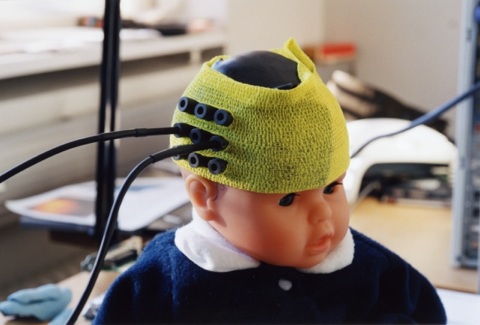
Think of toys as pivots– as Vygotsky did, as well as prior posts on this site regarding play. Toys are representation,. where a child may imagine that they are participating in something imagined and fantastic that might otherwise be too dangerous to participate in or initially too difficult to do. However, with the toy, the child might come closer to realizing the fantasy. What the experts in the article seem to ignore is that more complex toys can make the act closer to the real act — MIMESIS — imitation of the thing to be learned and played to gain competence and gain respect enough to engage in the real act through showing aptitude, knowledge, and competence. Read more
Summary: As losses continue to mount, price cuts remain slow to materialize and more and more blockbuster releases are delayed until 2010, the PC and video game industry finds itself at a crossroads. The big question: Will it power up in time to save itself from going the way of the arcade? With the stakes higher than ever, we ask the field’s best and brightest what’s causing the biz to short circuit, whether the virtual landscape has permanently changed, and how to save interactive entertainment. Join us for the conclusion of our critically-acclaimed season opener as we discover whether or not it’s too late to hit restart.
Freefalling sales. Skyrocketing unemployment. Studios tanking left and right. Tune in for the first of a special two-part series as we ask: Is it ‘game over’ for thousands of developers and publishers – and millions of fans – worldwide?
This video segment came form Digital Trends and I thought it interesting and perhaps worthy of dialog.
What do you think?
Need to read more?
Ask any family who’s ever dealt with addiction: When a friend is ailing, collapsing under the weight of their own dependencies, only two courses of action exist. Either you sit down, shut up and let nature take its terrifying course, or pause, take a deep breath and do what duty demands… step in and stage an intervention. And speaking as a player, parent, professional, fan and longtime ardent admirer of this medium so many cherish and adore, let’s not kid ourselves. To put it bluntly – the time has come to take the game industry aside and show it some tough love.

The Jekyll and Hyde Effect calls into question approaches to accountability and implementation of mandated approaches to research-validated techniques and assessment in classroom instruction. Dissonance between teachers core beliefs about student learning and these new mandates, as presented to them, may be creating two different identities, two different classrooms, and two different sets of books to satisfy mandates and continue doing what they know works. This study utilized discourse analysis, coding teacher artifacts as outcomes of genre chains with themes from mandates, policy, and law for classroom changes in curriculum and instructional assessment tools, materials, and professional development. The informants from the studies and findings from analysis of the artifacts reveal that many teachers do not feel that what is good for the spreadsheet is good for kids. This tension in core beliefs about learning and instruction need not lead to conflict– integration of assessment and appropriate implementation could enhance teacher and student experience. The transformation of policy to implementation was seen as problematic and led to misunderstanding and conflict, often based upon an inability to see standards, benchmarks, and assessments integrated into engaging, play-like activities such as games rather than the controlled, direct instruction that might cause resistance and disinterest by students and instructors, but easy to identify by administrators. The presentation makes a case for the importance of play in engagement and comprehension through review of literature on intelligence measures and new research on embodiment theory and the indexical hypothesis. Then it give examples of implementation.
New models of comprehension and memory validate the value of active and playful learning for cognitive enhancement and generative transfer. Data on academic performance and engagement measures from five years of games, play, and virtual space learning in K-20 classrooms will be presented in the context of assessment measures using a model for assessing cognitive growth. This is contrasted with educator beliefs, the efficacy of play, and the limitations of models of teacher professionalism creating a Jekyll and Hyde Effect. Though interviews, artifacts, and surveys, K-20 educators have expressed a willingness to embrace games, but have been reluctant to do so publicly for fear of professional reputation, as well as the ability to implement such pedagogical change.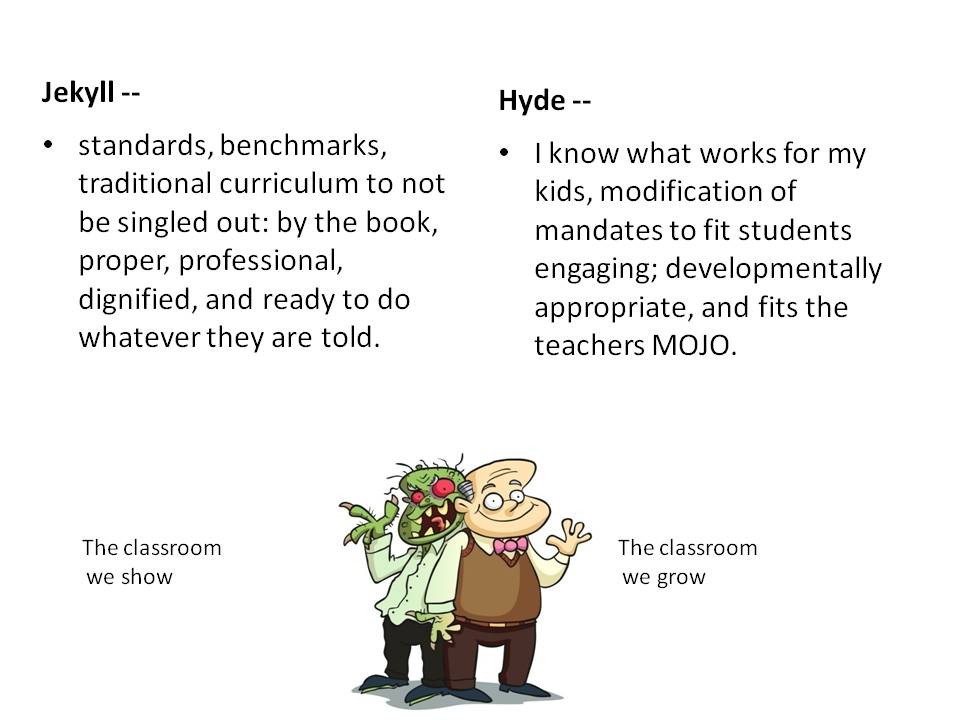
In this presentation, on overview of research, methodology, outcomes, and descriptions of implementation will be presented on how video games and virtual worlds were used to raise standardized reading scores. This evidence, methodology, and experience is presented with outcomes of surveys, interviews, and discourse analysis of teacher artifacts, and presents the institutional experiences of educators balancing the tension of using games and play, and the fear of being stigmatized as unprofessional at their teaching sites. The result begins to create a picture of creating two different sets of books, and two different teaching identities — Jeckyll and Hyde.
In this post, Ross Smith, Director of Test, Windows Security, at Microsoft, and one of the authors of The Practical Guide to Defect Prevention (Microsoft Press, 2007), describes the groundwork on their approach to using games as a tool for productivity and defect prevention through Portfolio Selection, Game Theory and “crowdsourcingâ€. He makes a case for a diverse portfolio of defect detection techniques and a means for utilizing crowds for human computation for developing these techniques. Smith asks:
“So, if the problem set for defect detection lies in our ability to balance our portfolio of discovery techniques, how can we involve the “crowd” to balance our portfolio on a grander scale?”
He states that:
The answer lies in the use of “Productivity Games.” Productivity Games, as a sub-category of Serious Games, attract players to perform “real work,” tasks that humans are good at but computers currently are not. Although computers offer tremendous opportunities for automation and calculation, some tasks, such as analyzing images, have proven to be difficult and error-prone and, therefore, using computers can often lower the quality and usefulness of the results. For tasks such as this, human computation can be much more effective. Additionally, by framing the work task in the form of a game, we are able to quickly and effectively communicate the objective and achieve higher engagement from a community of employees as players of the game.
Here is an excerpt and link to the original post:
Modern portfolio theory (MPT), based on Markowitz’s work, suggests that the return of an investment portfolio is maximized for any given level of risk by using asset classes with low correlations to one other. In other words, a diverse set of investments reduces risk and maximizes return. In a portfolio with two diverse assets, when the value of asset #1 is falling, asset #2 is rising at the same rate. MPT also assumes an efficient market—that is, all known information is reflected in the price of an investment. These factors contribute to an investor’s ability to create an “optimal portfolio†for his level of risk.
How does this apply to testing software? The effort we put forth in testing (or quality improvement) is our investment. Our return or investment yield is the number of defects discovered. Each of our techniques will yield a return of a certain number or percentage of defects. This is easily seen in the distribution of the “How Found†field of our defect-tracking database. In addition to the return of discovered defects, there is the risk of escaped defects: missed bugs that are found in the field. This is akin to investor loss.
The evaluation of our testing strategy based on the MPT principles exposes a set of deficiencies and enables us to improve the return on our testing investment while minimizing the risk of escapes, the same way investors maximize the return on their portfolios while minimizing the risk of loss of principle. The range of optimal portfolio selection, according to Markowitz, is called the “efficient frontier†and is derived by evaluating each asset’s correlation with every other asset’s correlation to determine the optimal allocation of all the asset classes. Once the efficient frontier has been determined for the asset classes being evaluated, the decision of which optimal portfolio to choose becomes a question of the level of risk tolerance.
In other words, once the efficient frontier has been determined for our defect discovery techniques (“how found†in the tracking database), we can use our tolerance for risk (how many bugs found in the field are we willing to accept as a reasonable level of risk) to estimate which test strategies to invest in, and how much/frequently we should invest. A diversified approach minimizes our risk and maximizes our return. When the defect yield of “how found = test case development†starts to wane, it’s time for “how found = customer†or “how found = ad hoc testing.†We are governed by the principle that the second bug is harder (and more costly) to find than the first. Yield curves through a project cycle illustrate this effectively. This is common sense to any seasoned tester, but the numbers give us a formula to predict and dictate the timing of behavior change.
The most important aspect of the diversified approach is to stay with the portfolio once it has been established, regardless of return. This takes a level of trust that we’re not used to at Microsoft and a belief that our techniques are good investments. Just as an investor might panic when a given investment fails miserably, we tend to over-react when we miss a certain type of bug. Just as a fund manager massages her investments to provide consistency, there are great defect prevention tools and techniques to improve our test strategies.
Game Theory and Human Computation
The relationship here is interesting. The year before winning the Nobel Prize, Harry Markowitz won the John von Neumann Theory Prize. From the Nobel Prize site:
“In 1989, I was awarded the Von Neumann Prize in Operations Research Theory by the Operations Research Society of America and The Institute of Management Sciences. They cited my works in the areas of portfolio theory, sparse matrix techniques and the SIMSCRIPT programming language.” John von Neumman was one of the leading mathematicians in his day, and instrumental in the development of game theory.
John von Neumann’s 1944 book, Theory of Games and Economic Behavior, helped set the stage for the use of math and game theory for Cold War predictions, stock market behavior, and TV advertising. He was the first to expand early mathematical analysis of probability and chance into game theory in the 1920s. His work was used by the military during World War II, and then later by the RAND Corporation to explore nuclear strategy. In the 1950s, John Nash, popularized in the film A Beautiful Mind, was an early contributor to game theory. His “Nash Equilibrium,†helps to evaluate player strategies in non-cooperative games. Game theory helps us to understand how and why people play games.
So, other than Markowitz winning the von Neumann award in 1989, how does MPT relate to defect prevention? The answer lies, seductively, in the use of crowd-sourcing and human computation: attracting the effort of “the crowd” to assist.
Wikipedia describes “crowdsourcing†as
“a neologism for the act of taking a task traditionally performed by an employee or contractor, and outsourcing it to an undefined, generally large group of people or community in the form of an open call. For example, the public may be invited to develop a new technology, carry out a design task (also known as community-based design[1] and distributed participatory design), refine or carry out the steps of an algorithm (see Human-based computation), or help capture, systematize or analyze large amounts of data (see also citizen science).”
and “human computation†as
“Human-based computation is a computer science technique in which a computational process performs its function by outsourcing certain steps to humans. This approach leverages differences in abilities and alternative costs between humans and computer agents to achieve symbiotic human-computer interaction.”
So, if the problem set for defect detection lies in our ability to balance our portfolio of discovery techniques, how can we involve the “crowd” to balance our portfolio on a grander scale?
The answer lies in the use of “Productivity Games.” Productivity Games, as a sub-category of Serious Games, attract players to perform “real work,” tasks that humans are good at but computers currently are not. Although computers offer tremendous opportunities for automation and calculation, some tasks, such as analyzing images, have proven to be difficult and error-prone and, therefore, using computers can often lower the quality and usefulness of the results. For tasks such as this, human computation can be much more effective. Additionally, by framing the work task in the form of a game, we are able to quickly and effectively communicate the objective and achieve higher engagement from a community of employees as players of the game.
One of the all-time greatest examples of a Productivity Game is the ESP Game, developed by Luis von Ahn of Carnegie-Mellon University (also well known for inventing the Captcha), in which players help label images. In the ESP Game, two players work together to match text descriptions of images to earn points. The artifacts of game play are text-based (searchable) descriptions of images (not searchable). More at http://www.gwap.com.
Following is a series of quotes and examples related to the importance, usefulness, and appeal of games.
As University of Minnesota researcher Brock Dubbels suggests, “Games provide the opportunity to experience something grand—flight simulators do not have the excitement that games do—games exaggerate and elevate action beyond normal experience to make them motivating and exciting. In World War 2, the likelihood of being in a dogfight was slim, but in the game ‘1942,’ you can find one around every corner. Games raise our level of expectation to the fantastic and our biochemical reward system pays out when we build expectation towards reward. Sometimes the reward leading up to the payout is greater than the reward at payout! A game structures interaction in ways that may not be available by default for special circumstances and projects. A game can also create bonds that hold people together through creating opportunities for relationships that one might not experience every day.”
Get Ready for EAT-IT

For two days in August we will be examining the state of the art in educational uses of new and emerging technologies in education. Come to the campus of Inver Hills Community College in Inver Grove Heights, Minnesota (southeast suburb of St. Paul) for a focused conference that will provide practical teaching tips and great ideas to prepare you for the start of school in the fall.
Enjoy engaging, informative, and entertaining talks that will not harsh your mellow.
vgAlt will be there for a keynote and a hands-on seminar on integrating games into traditional classroom instruction, as well as next generation hybrid courses that build upon notions of online and extend them with new interactive media into augmented reality.
Title:Â 
Professionalism
and the Jekyll and Hyde Effect
Subtitle:
Games facilitate learning acceleration, no one will dis your MOJO now professor.
Brock Dubbels
12:45 – 1:45
New models of comprehension and memory validate the value of active playful learning for generative transfer:Â five years of data collection on standardized reading assessments are shared from a curriculum of games, play, and virtual spaces in k-20 classrooms will be presented on the value of virtual worlds and interactive games used with developmental students and instructors.
In this presentation, on overview of research, methodology, outcomes, and descriptions of implementation will be presented on how video games and virtual worlds were used to raise standardized reading scores and improve reading performance with developmental reading exit examinations. This evidence provides some corollary to educators’ hesitation in using games as methodology for data collection and curriculum.
This hesitation was documented through genre chain analysis in the form of surveys, interviews, and discourse analysis of teacher artifacts, and the institutional experiences of educators balancing the tension of using games and play, and the fear of being stigmatized as unprofessional at their teaching sites.
The outcome of the genre chain analysis begins to create picture of educators creating two different sets of books, and two different teaching identities — Jekyll and Hyde. Where we may have a feeling games can be powerful learning tools, but dare we get caught using them?
Jekyll — standards, benchmarks, traditional curriculum to not be singled out — proper, professional, dignified
Hyde — Dude, I know what works for my students — the role of interpretation and translation of policy, climate, standards, content and expectation as genre chains– INTASC, Standards of Effective Instruction, Personal Development Plans, learning walks, oversight accountability, parent letters, and report cards–and offering coursework that is engaging and developmentally appropriate, and fits the teachers MOJO.
In this presentation evidence from classroom success and data collected from standardized assessments and cognitive neuroscience is presented. You can come out and relieve your fears of being caught using games in the classroom. Games are effective in learning acceleration. You no longer need to Hyde it.
You can have your fun and EAT IT too.
 Come to the Break out session 2:00 – 3:00
Track 2: Brock Dubbels –
Video Games as Learning Tools
In this session, participants will be exposed to experiential learning and access to next generation game systems and an example of curriculum as games relate to content and can be used for developmental reading, technical writing, and technology.
Other content areas will be discussed, along with an approach called 9 ways to use video games for learning acceleration.

Make sure that you come to Games in Education
New York August 5th and 6th!
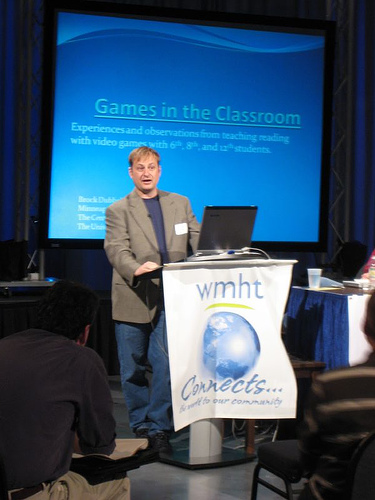
This event is well worth the trip just for the networking.
This is my third year participating in this conference, and every year the bar is raised with excellent speakers, useful and illuminating workshops, and excellent hosts.
Check out the program for yourself! http://www.gamesineducation.org/
Earn 5 clock hours by taking conference notes and summarizing what you have experienced.
Tell us what you are learning during the two day conference and get clockhours!
Come and connect, reflect, and carry this into your classroom.
Sign up for 49.95 at Professional Learning Board
Facilitated by vgAlt instructor Brock Dubbels
Link to sign up
Video Games Learning Arcade
for Parents and Educators

Come and Connect, Network, Play to Learn
Workshop attendees will:
- Play next gen gaming consoles like the X Box 360, Playstation 3, and the Wii
- Play traditional systems like the X Box, Playstation 2, Sega, V Tech
- Play computer-based games
- Experience a variety of titles for k-20 students
- Receive curriculum proven over years of classroom implementation and featured in the Star Tribune, NEA Today, Ed Week, WCCO and newspapers around the USA.
- Receive CEUs for professional Development
Course attendees are free, and there are 20 spaces available for non-enrolled attendees at $29.95
— also good towards the cost of the full course!
To reserve your space for this workshop, contact
Brock@vgAlt.com

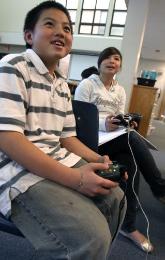
Learning is a game to Brock Dubbels and the students in his class at Seward Montessori in Minneapolis.
They spend their school time together playing off-the-shelf video games for the Nintendo Wii and other popular systems. But the 26 sixth- to eighth-graders aren’t learning from the games’ content. They’re gaining key skills simply by playing and studying the games.
“It connects to their lives,” Dubbels explained. “Research shows that kids want to perform where they have competence. Games are part of their lives.”
That’s where Dubbels’ Video Games as Learning Tools class comes in. Over a three-week period, the kids split up into groups and play video games. They also take notes. The goal is to explain how the game is played, how a player might win and how the game is designed. By the end of the session, the students will have created a multimedia presentation, including lots of writing, about their games that is then uploaded to the Web.
It’s the modern version of a book report.
Sure, the kids are playing. But Dubbels, who has a background in cognitive psychology, says they’re also improving reading comprehension, learning to work cooperatively, building technical-writing skills and incorporating technology into their studies.
That resonates with the kids who elected to take Dubbels’ class, such as Genevieve Paule, 14.
“I like video games a lot, and I thought it would be cool learning about how to learn from them,” she said on the first day of the class in the school’s media center. “It’s going to be really interesting, because all I’ve ever done before is play them for fun. But now I get to play them for class and actually learn about how they help people learn.”
As Genevieve confabbed with three other girls about what game they wanted to play, Simon Quevedo, 12, and Jess Sanchez, 14, worked together to set up an old Nintendo 64 system that Sanchez had borrowed from his dad.
“I like the part about learning how the games can help you in the future and how they’re made, instead of just playing them,” Jess said as he connected the game console to a TV. “It makes me think of them in a different way.”
Both boys said they might one day like to learn how to design video games.
“Oftentimes, kids don’t think very deeply or analytically about the video games that they play,” Dubbels said. “They don’t learn how to deconstruct; we don’t give them the time to seriously reflect and we don’t ask them to evaluate. I think that makes us helpless in a consumer vacuum, where we are inundated with so much stuff that we never get the time to think carefully and thoughtfully about it. And as a child, that’s your chance.”
Modern learners wired differently
Other educators want to explore that opportunity, too. Dubbels will spend much of his summer showing other teachers how the class works. His training projects include an online course for Minneapolis Public Schools, in-service training for Richfield Public Schools and seminars for a consortium of school districts in upstate New York. He also will be presenting at the Games in Education Conference in New York and at the Games+Learning+Society Conference in Wisconsin.
Dean Breuer, instructional technology coordinator for Richfield Public Schools, says he knows exactly where Dubbels is coming from in reaching out to kids through something they know well.
“These modern learners, their brains are just wired differently,” Breuer said.
He said that he also teaches with books, of course, and that there are times when discussions and lectures are important. But, Breuer added, “if all you do are more traditional methods of instruction, it may not be as clear to 21st-century learners that you are relevant, that you get that they are different.”
Andy Reiner, 33, executive editor of Minneapolis-based Game Informer magazine, likes Dubbels’ approach. Reiner said he was fed “a steady diet of book reviews” when he was in school. “In retrospect, you’d think I attended school in the 1800s,” he said.
Reiner clarified that he’s not diminishing the importance of books. But he pointed out that evaluating a video game, for example, requires a different writing style and critical analysis than a book review.
“This isn’t just about students having fun with their homework,” Reiner said. “By incorporating video games into his teaching, Dubbels is expanding his students’ technical-writing skills.”
He added: “And why shouldn’t school be fun? For one student, a fun review might be reading the work of Edgar Allan Poe. For another, it could be playing ‘The Legend of Zelda,’ watching ‘Star Trek,’ or listening to Green Day. We choose our occupation later in life. Why can’t we choose our homework if our teacher is willing to teach us the skills that go with it?”
The more complex, the better
Dubbels, 42, is a lifelong gamer who grew up in the shadow of Atari in Cupertino, Calif. In class, he has a PlayStation 2, an Xbox and a Wii — all his personal systems. The students bring in their systems, too.
The kids also can bring in any game they want, as long as it is rated Everyone or Everyone 10+ by the Entertainment Software Rating Board. Teen-rated games, which are suitable for players 13 and older, can be played with parents’ permission.
Any game will do, Dubbels says. His classroom favorites include the cerebral first-person shooter “Metroid Prime 3: Corruption,” sports games such as “Tiger Woods Golf” and “NBA Live,” and movement-based titles such as “Shaun White Snowboarding” and “Dance Dance Revolution.” The Xbox 360 version of the latter is what Paule and her group decided to do.
“The more complex the game, the better — because the deeper we can dig into the game, the more I love it,” Dubbels said.
Parents must sign a permission slip for kids to take the class. But Dubbels acknowledges that traditionalists might not like his video-game approach to teaching basic skills.
“To be quite honest, most parents have bought their kids game systems,” he said. “There are some people who are a little bit up in arms, but they just don’t understand about games and kids.”


